A Typology of Slop
An essay in which I humbly suggest that we all Move Slower and Stop Breaking Things.
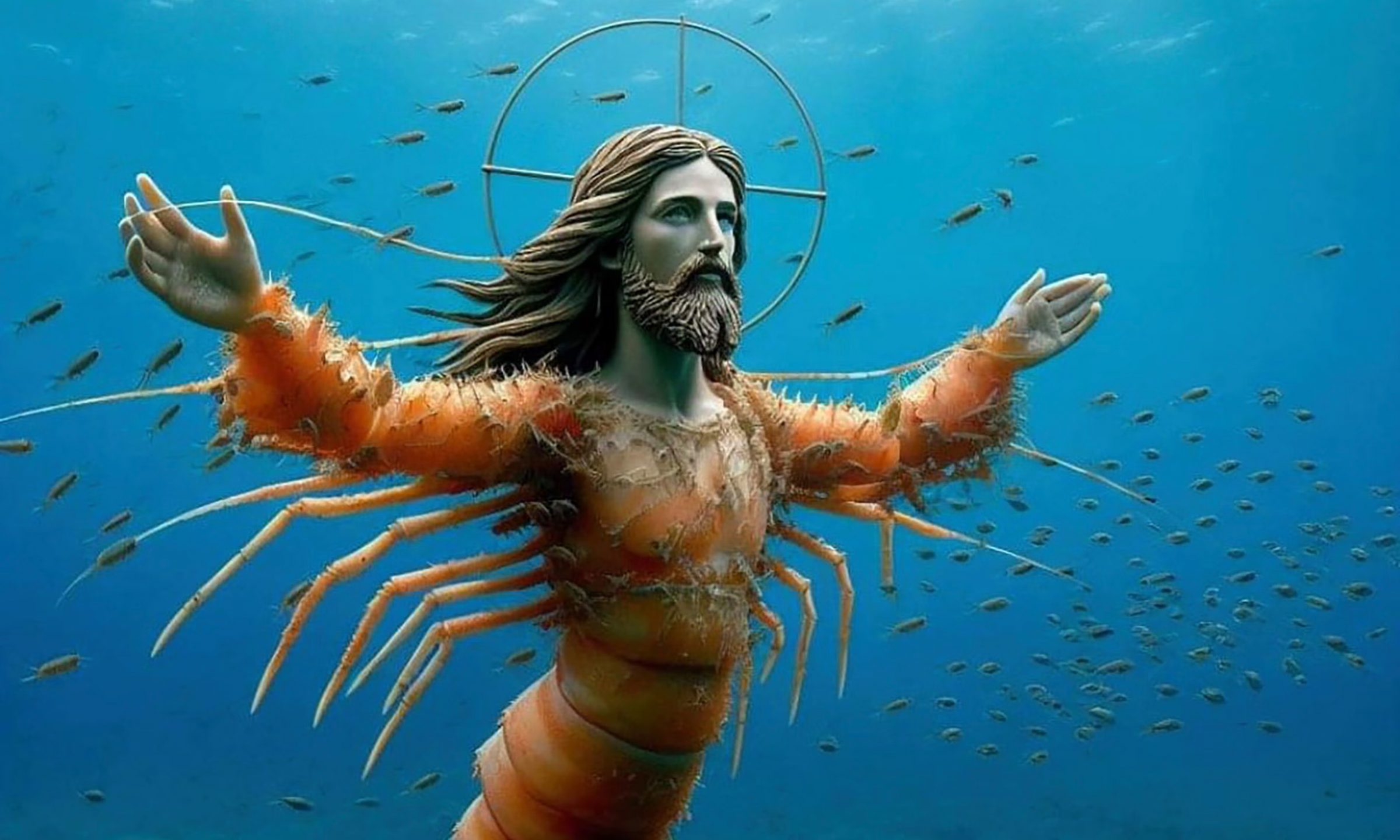
There’s an idea that’s been kicking around for a while called the Dead Internet Theory which posits that the vast majority of what we encounter on the web – including social media, blogs, forums, news and marketing spam – is actually artificially generated. According to this theory, bot-generated content began to crowd out human-generated content sometime in the mid 2010s and now we’re all trapped in a hollow imitation of the web which has been intentionally designed to pacify us and prevent us from acquiring any sort of political consciousness.
Like all grand conspiracy theories the Dead Internet Theory is, at heart, a comforting alternative to the real state of affairs. Which is that Silicon Valley’s reluctance to exercise any sort of moral or ethical responsibility towards the general public has simply enabled a vast number of bad actors to flood the web with disinformation from below – whether that be in the form of advertising, content marketing spam, scams or AI-generated entertainment slop. There’s no top-down plan and no puppet-master. There’s just perverse incentives and a lack of regulation.
As far as I can tell the internet isn’t dead yet but it certainly isn’t healthy. Last time I wrote about Generative-AI I compared it to a nuclear meltdown but that was when I was still dwelling on HBO’s Chernobyl miniseries. More recently I visited Adelaide where an algae bloom the size of Italy was choking out all life along South Australia’s coast. Given that the founding metaphor for navigating the web was ‘surfing’ we might think of today’s internet as a coastline caught in the grips of a similar disaster. Rest assured that if there’s a catastrophic oil spill or coal-seam fire sometime in the near future I’ll update my metaphor accordingly.
Last time the focus was on text generators like Chat-GPT but this time I want to take a look at image generators like Midjourney, Stable Diffusion and Dall-E and video generators like Sora, Veo 3 and Seedance. For the sake of convenience I’m going to refer to all of these programs as generative image and video models because they all operate in roughly the same way and produce roughly the same results. Some users prefer one application over another for subtle aesthetic reasons but the underlying technology remains largely the same.
Generative text-to-image models work like this: they take hundreds of thousands of images that have been painstakingly reviewed and labelled by people working for poverty wages in the global south and lump them into a database. These ‘hand-labelled’ image libraries are combined with the millions of other images that have been purposefully or inadvertently labelled by people like you and me whenever we’ve completed those annoying CAPTCHAs to prove that we’re human. Ultimately every one of those spot-the-traffic-light puzzles is incrementally helping to make the world legible to automated systems.
When all these labeled images are lumped together they form a massive training corpus that’s accessible to tech companies. Using some fairly complicated forms of linear algebra, AI labs set up competing bots – referred to, somewhat misleadingly, as ‘neural networks’ – which attempt to recreate images purely through pattern recognition. The generator bot attempts to produce a realistic fake image (something novel that nonetheless resembles the subject matter in its training dataset) while the discriminator bot tries to detect whether that image is real or fake. Over time these bots get better at both producing and detecting fake images. This system is known as a Generative Adversarial Network (GAN).
When the AI companies are satisfied that their model has gone through enough rounds of training they slap a version number on it, release it to the public and allow people to request images via a chatbot.
Users can also prompt the models using existing images. So a bored landscaping contractor might upload a photo of a swimming pool at a client’s property, upload a photo of the company’s forklift and then have Gen-AI combine the two images in order to convince their boss that an expensive accident has taken place (or just pretend to do so for internet points). This, of course, is a fun and light-hearted use case for Gen-AI and definitely not a demonstration of how easily the technology can be abused by people looking to defraud an insurance company or perpetrate a hoax.
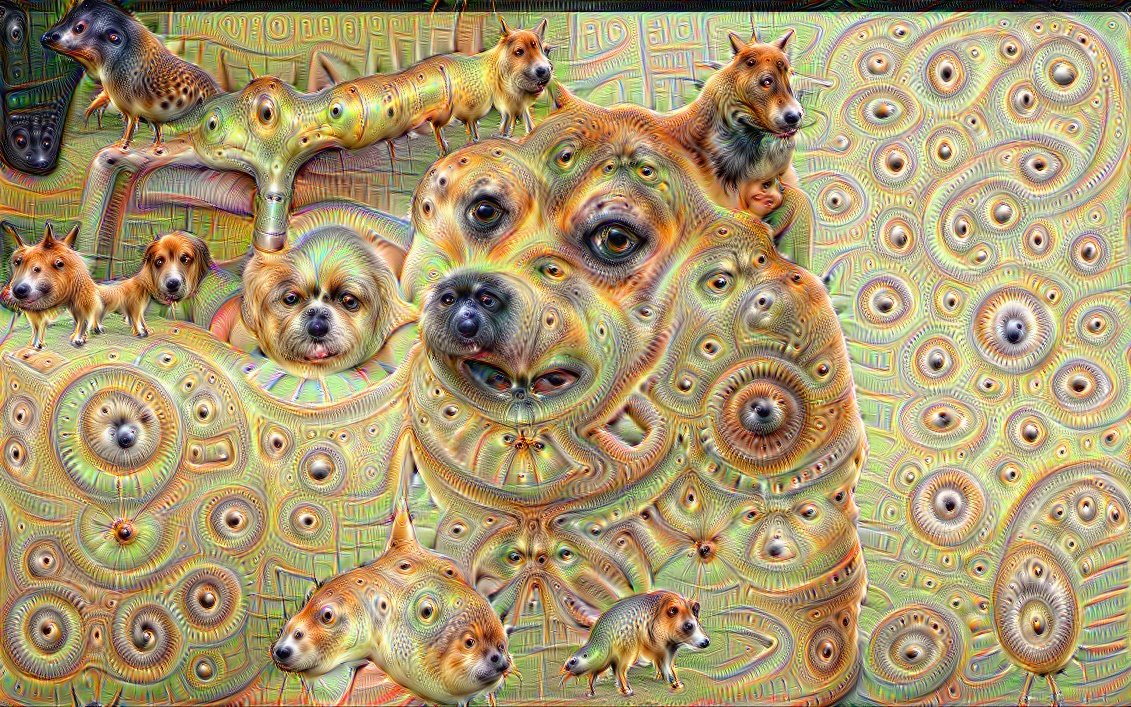
Generative image models were first introduced to the public in the mid 2010s via a Google research project designated Deep Dream. During this experimental period the output of these models was often used to show how neural networks ‘viewed’ the data they were working with. The results were invariably quite weird and wonderful – highlighting the logic and shortcomings of the technology itself. Because the training data set included a disproportionate number of human faces and an exhaustive library of various dog breeds these early models tended to produce a lot of weird iridescent portraits of dogs comprised of smaller dogs and bizarre creatures made from clusters of eyes that looked like something described in the Book of Revelations.
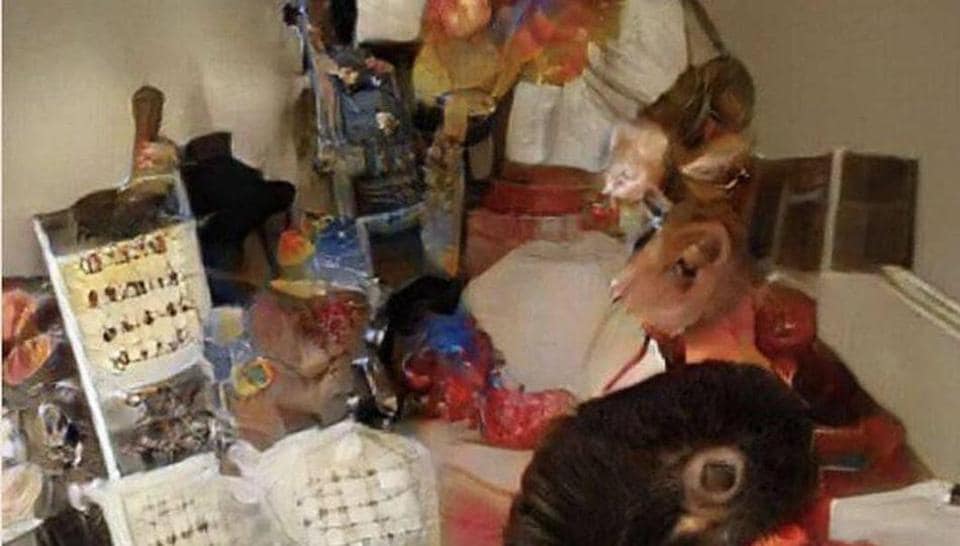
Possibly the most interesting of these early experiments was a half-baked image produced by a tool called Ganbreeder in 2019 which seemed to simulate the effect of a severe concussion. At first glance the image appears to be a low-res photo of a teenager’s messy bedroom. But the longer you look at it the harder it is to tell what you’re actually looking at. All of the supposed objects turn out to be amorphous blobs and yet each one seems to be right at the threshold of recognition.
Even after years of improvements and an exponential increase in training data these programs remain good at some things but practically useless at others. They are, for example, good at remixing imagery from popular culture. They’re also good at converting images from one illustration style to another. So if you fire up Google’s Gemini chatbot and ask for a picture of Charles Bronson dressed as Charlie Brown the bot will produce something that matches that prompt. However, if you ask it to generate an image that requires any sort of spatial awareness the algorithm veers off course pretty quickly. For example, I asked Google’s Gemini chatbot to provide a floorplan for a four bedroom house with a double garage and a circular driveway. In response it gave me a house with windowless bedrooms, pantries with toilets in them, a lounge room with a double-layered wall and a driveway that connected the laundry to the master bedroom.

Despite having been shoe-horned into countless online systems the promised productivity gains and commercial benefits of Gen-AI haven’t really materialised. Instead the AI arms race seems to have ushered in a golden age for online fraud. Using Generative AI, scammers can now conduct hyper-personalised phishing attacks through an army of synthetic social media accounts.
Meanwhile, desperate gig-workers use the same technology to flood newsfeeds with fake news while Tate-addled misogynists have turned sexual harassment into a cottage industry by generating ‘deepfake’ pornography of high-profile women. The companies responsible for this state of affairs continue to claim that this upheaval is simply the teething stage of some godlike superintelligence but, as of 2026, generative AI mostly appears to be a big scam that enables people to conduct smaller scams.
It should have been obvious to anyone with an actual neural network that this technology would be used to amplify fraud, enable sexual harassment and spread disinformation. Nevertheless U.S. tech companies have stubbornly refused to take responsibility for any of these unpleasant externalities. Their credo is the Facebook motto: Move Fast and Break Things.
What they’re breaking at the moment seems to be society’s consensus of what is and isn’t real.
Over the last few years new strains of generative-AI have appeared so quickly that it can be hard to understand where this material is coming from or why it’s being generated in the first place. Detractors like to call anything AI-generated ‘slop’ but that’s a broad term for a dizzying array of fauxtos, filters, forgeries, deep-fakes and propaganda.
Intent matters when it comes to Generative AI. There’s a real difference between the people who convert their profile photo into a Studio Ghibli cartoon character and the people who ask Elon Musk’s chatbot to strip the clothing off a female pop-star.
Given that all Gen-AI tools are broadly comparable and all social media channels are currently saturated with slop, I’ve chosen to categorize Gen-AI outputs according to the motivation and intent of those producing it. Each category will be accompanied by one or two case studies to illustrate these motivations.
So join me as we dive into the fetid waters of the Gen-AI internet.



Leave a Reply